
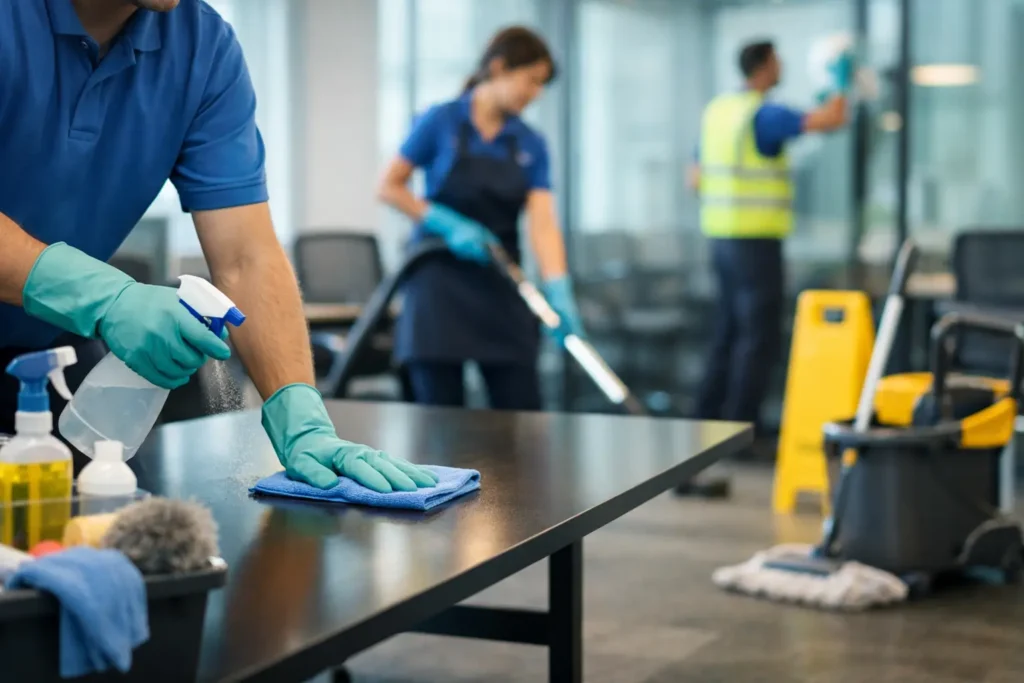
If your office toilets are spotless but the desks are dusty by midday, or your reception looks tidy yet bins overflow in the back rooms, your cleaning is not really meeting standard. A proper guide to commercial cleaning standards is not about making a workplace look passable for an hour. It is about setting a clear, consistent level of cleanliness that supports hygiene, presentation and day-to-day operations.
For most businesses, the challenge is not deciding whether cleaning matters. It is deciding what “good enough” actually looks like, how often each task should happen, and how to keep standards consistent without wasting time or budget. That is where a practical standard makes the difference.
What commercial cleaning standards actually mean
Commercial cleaning standards are the agreed expectations for how clean a workplace should be, how cleaning should be carried out, and how results are checked. In simple terms, they create a benchmark. Instead of relying on vague instructions like “give the office a clean”, the standard defines what must be cleaned, how thoroughly, and how often.
That matters because different commercial spaces have different risks. A small office may focus on washrooms, kitchen areas, desks and floors. A medical setting, nursery or busy customer-facing premises will have tighter hygiene expectations and more frequent touchpoint cleaning. The point is not to overcomplicate the job. It is to make sure the cleaning matches the real use of the space.
A good standard should cover appearance, hygiene and consistency. Appearance is what clients, staff and visitors notice first. Hygiene is what protects health and reduces the spread of germs. Consistency is what stops standards slipping after the first few weeks of a contract.
Why standards matter more than a basic cleaning rota
A rota tells cleaners when to attend. It does not always tell them what success looks like. That is why many businesses think they have a cleaning system when they really only have a schedule.
Standards give managers something measurable. If there is a complaint about streaky floors, dusty skirting boards or poorly maintained washrooms, the issue can be checked against the expected result. It also makes onboarding easier when more than one cleaner works on site, because everyone follows the same service level rather than their own interpretation.
There is also a compliance angle. Employers have a duty to provide a safe and hygienic working environment. Cleaning standards support that duty, especially in shared spaces such as toilets, kitchens, meeting rooms and high-contact areas. Even in low-risk offices, poor cleaning can lead to avoidable problems such as odours, pest attraction, worn flooring and a generally neglected appearance.
A guide to commercial cleaning standards by area
The easiest way to set standards is to break the building into zones. Each zone has its own cleaning priorities.
Reception and customer-facing areas
These areas set the first impression. Floors should be free from visible dirt, dust and litter. Glass should be clear, not smeared. Desks, counters and seating should look presentable throughout the working day, not just straight after cleaning.
In many businesses, this zone needs more frequent touch-up attention than deeper cleaning. A polished entrance loses impact quickly if mats are soiled or fingerprints build up on doors.
Office workspaces
Office cleaning standards should cover floors, desks, bins, internal glass, shared equipment and touchpoints such as door handles and switches. The exact desk-cleaning approach depends on whether the workplace uses hot desking, fixed desks or privacy rules around paperwork and devices.
This is one of those areas where it depends. Some businesses want full desk-surface cleaning daily. Others prefer cleaners to avoid desks unless they are visibly clear. The standard should settle that in advance so there is no confusion.
Kitchens and breakout spaces
These areas usually need a stricter standard than the general office. Worktops, sinks, cupboard fronts, appliance exteriors and floors should be cleaned regularly enough to prevent grease, spills and food residue building up. Bins should be emptied before odours become an issue, not after.
Shared kitchens are often where complaints start, because usage is unpredictable. A light clean once a day may work for a small office but fall short in a busy workplace with staggered shifts. Frequency should reflect actual use.
Toilets and washrooms
If you want one area that defines commercial cleaning standards, it is the washroom. Toilets, basins, taps, mirrors, dispensers, cubicles and floors all need routine attention. Supplies such as soap, hand towels and toilet tissue should be checked as part of the standard, not treated as an afterthought.
Washrooms are also where poor standards become visible fastest. Limescale, splash marks, empty dispensers and unpleasant smells tell staff and visitors that cleaning is either too infrequent or not being checked properly.
Floors and carpets
Hard floors and carpets need different standards and different frequencies. Daily vacuuming or mopping may be enough for general upkeep, but that will not replace periodic deep cleaning. Carpets hold dust and tracked-in dirt over time. Hard floors can lose finish and become harder to maintain if they are not treated properly.
This is a common trade-off area. A business may cut back on periodic floor care to reduce short-term cost, but that often leads to earlier wear, poorer appearance and more expensive restoration later.
How to set the right cleaning frequency
One of the biggest mistakes businesses make is copying another site’s schedule. Cleaning frequency should be based on footfall, layout, hours of operation and the type of work taking place.
A small office open five days a week may need daily general cleaning and less frequent deep cleaning. A customer-facing premises with constant traffic may need washroom checks multiple times a day and regular daytime cleaning support. Warehouses, communal blocks and post-build environments all need different approaches again.
This is why any useful guide to commercial cleaning standards has to allow for site-specific planning. There is no single perfect frequency for every building. The cleaner standard is the one that matches the building as it is actually used.
What a professional cleaning specification should include
If you are comparing providers or reviewing your current arrangement, ask for more than a price and a visit schedule. A proper cleaning specification should state which areas are covered, the tasks included, the expected frequency, any exclusions, and who supplies consumables or equipment.
It should also explain quality checks. Without that, standards can drift quietly. Missed skirting boards, poorly cleaned corners and inconsistent washroom checks are often signs that nobody is auditing the result.
For local businesses in Birmingham, this can be especially useful where buildings vary from modern offices to older mixed-use premises. The cleaning plan needs to fit the property, not the other way round.
How standards are maintained in practice
A standard only works if it is monitored. That usually means site checklists, supervisor inspections and a clear process for reporting issues quickly. Fast response matters because a small cleaning problem can turn into a repeated complaint if it lingers.
Training matters just as much. Even basic tasks such as washroom sanitising, floor care or colour-coded cloth use need consistency. Trained cleaners work faster, avoid cross-contamination and know what to look for before problems become obvious.
Communication is another part of the standard. If your business changes opening hours, adds staff, hosts more visitors or refurbishes part of the premises, the cleaning plan should be reviewed. Standards are not fixed forever. They should adapt when the site changes.
Choosing a cleaning company that understands commercial standards
Price matters, but the cheapest quote is not always the best value. If a provider cannot clearly explain their cleaning specification, quality checks and response times, the service may look affordable at first and become frustrating later.
A dependable commercial cleaner should be able to assess your site, recommend a realistic frequency, and explain what level of result you can expect. They should also be straightforward about what falls under routine cleaning and what counts as periodic deep cleaning. That clarity helps avoid disappointment on both sides.
For many businesses, convenience matters as much as technical detail. Quick quoting, simple booking and responsive communication save time, especially if you manage multiple priorities already. That is one reason companies choose providers such as YG Cleaners Birmingham for practical commercial support rather than trying to coordinate separate contractors for every cleaning need.
Red flags that your current standards are too low
If staff are regularly raising the same issues, your standard is probably not clear enough or not being met consistently. The same applies if cleaning only looks good immediately after a visit, if washrooms run out of supplies, or if high-touch surfaces are being overlooked.
Another warning sign is when your cleaner and your manager have very different ideas of what is included. That gap usually points to a weak specification, not just a poor shift.
The right standard should feel realistic, visible and repeatable. It should protect hygiene, support your image and make the building easier to manage, not harder. If your current arrangement leaves too much open to interpretation, tightening the standard is usually the fastest way to improve results.
A cleaner workplace is not just about presentation. It affects how staff feel, how visitors judge your business and how smoothly the site runs each day. Set a clear standard, match it to the way your premises are used, and you give yourself a better chance of getting consistent results without constant chasing.
Pingback: Is Professional Carpet Cleaning Worth It? | YG CLEANERS
Pingback: Office Cleaning vs In-House: Which Works Best? | YG CLEANERS