
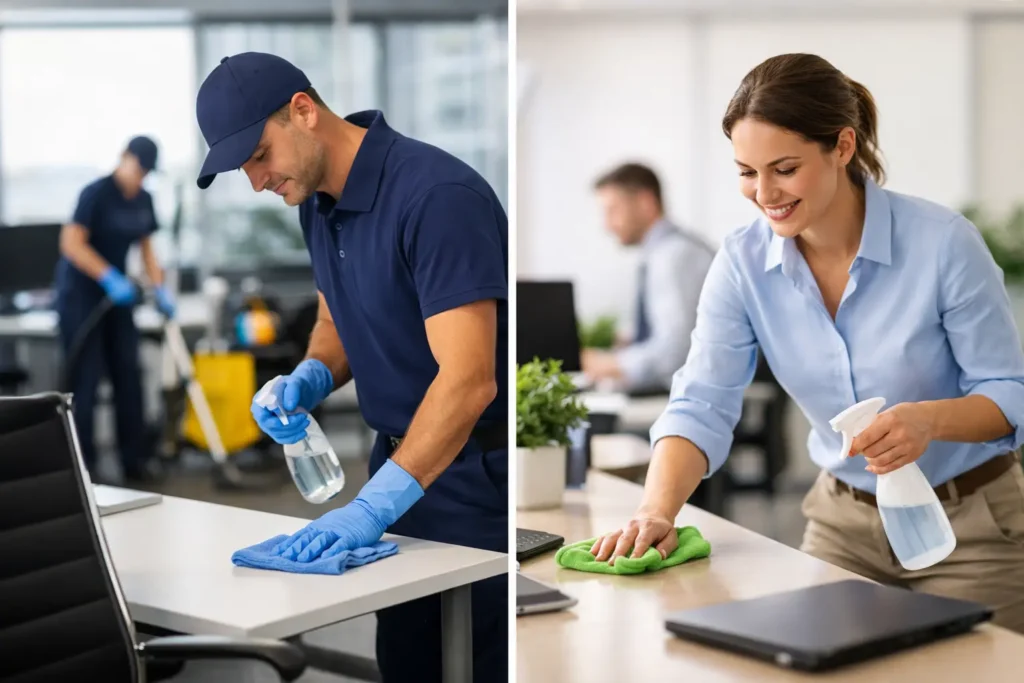
A clean office looks simple on the surface, but the way you achieve it has a direct effect on cost, staff time and day-to-day standards. When businesses compare office cleaning vs in house, they are usually trying to solve one practical question: is it better to employ cleaners yourself or bring in a professional cleaning company?
The right answer depends on your size, schedule and how much management time you want to spend on cleaning. For some businesses, an in-house cleaner can work well. For many others, outsourcing gives better consistency, less admin and a more flexible service. The key is to look past the hourly rate and assess the full picture.
Office cleaning vs in house: the real difference
The biggest difference between office cleaning vs in house is responsibility. With an in-house arrangement, your business takes on recruitment, training, cover for sickness or holidays, supervision, supplies and ongoing quality control. With outsourced office cleaning, those tasks sit with the cleaning provider.
That matters more than many managers expect. Cleaning is not just about ticking off bins, desks and washrooms. It is about keeping standards consistent every week, even when staff are off, workloads change or the office needs extra attention after a busy period.
If your team already has enough on its plate, managing cleaners internally can become another operational job that nobody planned for. If you prefer one point of contact, quick scheduling and less internal admin, outsourcing is often the cleaner option in every sense.
Cost is not just the hourly rate
On paper, hiring someone in-house can look cheaper. You see a wage and assume that is the main cost. In practice, there is more to account for.
An in-house cleaner may involve National Insurance, pension contributions, holiday pay, sick pay, recruitment time, uniforms, products, equipment and management oversight. If that person leaves, you also face the cost of replacing them and the risk of standards slipping in the meantime.
An outsourced office cleaning contract usually wraps labour, supervision and often equipment or agreed supplies into one service fee. That can make budgeting easier and remove surprise gaps in cover. It also means you are not paying your office manager or facilities lead to spend time chasing stock, rearranging shifts or checking whether a vacuum needs replacing.
This is where office cleaning vs in house becomes less about the cheapest quote and more about value. A lower apparent wage can still cost more overall if it creates extra admin and inconsistent results.
Control versus convenience
Some businesses like the feeling of direct control that comes with an in-house cleaner. You set the routine, change tasks quickly and keep the person fully integrated into your workplace. In a small office with predictable needs, that can be a genuine advantage.
But control comes with obligations. Someone still has to manage performance, handle absence, maintain supplies and step in when things go wrong. If the cleaner is unavailable, the office does not stop needing attention.
Outsourcing shifts that pressure away from your team. A professional provider should supply trained staff, organise cover and keep the service moving with minimal disruption. That is a major benefit for firms that want a clean office without turning cleaning into an internal management project.
Quality depends on systems, not just good intentions
One of the biggest strengths of a professional cleaning company is process. Good providers do not rely on one person remembering what needs doing. They work with checklists, supervision, training and clear standards.
An in-house cleaner may be excellent, especially if you hire well and support them properly. But quality can vary if there is limited training or no structured oversight. Cleaning standards often slip gradually – missed corners, inconsistent washroom checks, smudged glass, bins left too long – until someone in the office starts noticing the place feels tired.
With outsourced cleaning, quality should be easier to monitor because there is an agreed scope of work and a service contact to speak to if anything needs adjusting. That accountability matters in client-facing offices where presentation affects first impressions.
Flexibility matters more than many offices realise
Your office cleaning needs may not stay the same all year. Staffing levels change. Meeting rooms get heavier use. Flu season increases pressure on touchpoints and washrooms. Tenants move. Refurbishment work creates extra dust. Seasonal deep cleans become necessary.
An in-house model can struggle with these changes unless you have spare capacity built in. One cleaner may handle the usual routine but not the sudden extras.
Outsourced cleaning tends to be more flexible because extra visits, deeper cleans or specialist support can be arranged through the same provider. That is especially useful for businesses that want regular office cleaning alongside carpets, kitchens or one-off intensive work without coordinating several separate contractors.
Reliability and cover are often the deciding factor
Reliability is where outsourced cleaning often pulls ahead. If your in-house cleaner is off sick, on annual leave or leaves the role entirely, you need a back-up plan immediately. Without one, standards drop fast.
That can create a poor experience for your staff and an even worse one for visitors. Overflowing bins, untidy toilets and dusty reception areas do not take long to affect how your business is perceived.
A professional office cleaning provider should be able to arrange cover and keep the routine in place. For busy businesses, that continuity is worth paying for. It reduces risk and protects your working environment without dragging your own team into last-minute problem solving.
When in-house cleaning makes sense
There are situations where keeping cleaning in-house is reasonable. If you run a very small office, need only limited daily tasks and already have internal management capacity, hiring directly can work. It may also suit businesses that want the same person on site every day and have the time to train and supervise them properly.
In-house can also make sense where there are unusual security requirements or very specific routines that are easier to manage internally. Even then, it only works well if you are prepared for the employment and operational side of the role, not just the cleaning itself.
When outsourced office cleaning is the better fit
For many offices, outsourcing is the better option because it is simpler, faster to organise and easier to scale. If you want trained cleaners, dependable attendance and less internal admin, the case is strong.
It is particularly useful for growing businesses, shared offices, professional services firms and any workplace where appearance matters but management time is limited. A local provider can also respond more quickly when schedules change or an urgent clean is needed.
For businesses in Birmingham, that local responsiveness can make a real difference. Fast quoting, straightforward booking and regular contract cleaning under one provider are practical advantages, not marketing extras.
Questions to ask before you decide
Before choosing either model, be clear about what your office actually needs. How many hours of cleaning are required each week? Do you need daily attention or just a few visits? Are washrooms, kitchens and high-touch areas seeing heavy use? Will you need periodic deep cleaning as well as routine maintenance?
Then consider who will manage the service. If you choose in-house, who handles recruitment, payroll, supplies, training and cover? If you outsource, does the provider offer clear standards, reliable communication and flexibility when your needs change?
These questions usually bring the answer into focus. The wrong choice is often made when businesses compare wages to quotes without factoring in management time, absence cover and consistency.
The smarter choice is the one that saves time as well as money
Office cleaning should support your business, not create extra work around it. That is why office cleaning vs in house is not purely a finance decision. It is an operations decision.
If you have the structure and time to manage cleaning internally, in-house may suit you. If you want professional standards without the staffing burden, outsourcing is usually the more efficient route. Many companies find that once they account for reliability, flexibility and reduced admin, professional office cleaning offers better value than it first appears.
The best setup is the one that keeps your workplace clean, presentable and easy to run week after week. If cleaning has started to feel like another task your team has to chase, that is usually the sign to choose the option that gives you your time back.